Sunday, 19 October 2014

Research: Anita Berber

Anita Berber was a very famous German dancer during the 1920s, and it is claimed that no one of the present day would know who Anita Berber was, had it not been for Otto Dix and his painting of her in 1925.  She danced in the nude in nightclubs, appeared in soft porn films, drank cognac daily, was addicted to cocaine and opium, was never seen in public without wearing a heavy face of make-up and she died at a young age.

Anita Berber; Berlin's Queen of Decandence
Available: http://brucesterling.tumblr.com/post/60888693735/nitratediva-weimar-cabaret-goddess-anita-berber

Berber was born in 1899 in Dresden to Felix and Lucie Berber, however she was raised mostly by her grandmother.  At the age of 14 she joined her mum in Weimar, and then in 1915 they both moved to an apartment in Berlin.  Berber began acting classes, through which she was spotted by the dance choreographer Rita Sacchetto.  In February 1916 she made her debut with the Sacchetto dance-troupe and throughout 1916 and 1917 Anita Berber was becoming a rising star.  By 1918 she had made her first nine silent films and then in 1919 she married the young screenwriter Eberhard von Nathusius.  Whilst her film career was flourishing, Berber's personal life was getting out of control with rumours of lesbian and S&M sex affairs following her tour to Vienna.
Back in Berlin during the Winter of 1919, Anita Berber spent her nights in luxury hotels and restaurants wearing just a coat, with her pet monkey around her neck and an antique brooch that was usually filled with cocaine.  Whilst her cabaret career was blossoming and her reputation was growing, Berber's film career was not doing so well, due to her addictions and behavioural aspects making her a liability to work with.
Berber's marriage to Eberhard von Nathusius sadly ended in 1921, and following that she dated many men and women, including Marlene Dietrich.  Then in 1922 Berber met the dancer and poet Sebastian Droste and they quickly decided that they wanted to create something brilliant together.  July 1922 brought bookings for performances of their production 'The Dances of Depravity, Horror and Ecstasy' in Viennafor the November, but Droste's insincere promises and the pair's debts along with contract breaches and double booking themselves, led to them being banned from the International Artists Union (IAU) and no one could book them for two years.  By the end of 1922, Berber had violated the rules of the ban many times, she had been arrested for theft and assault, and so she was expelled from Vienna.
Otto Dix's painting of Anita Berber
Available: http://www.nndb.com/people/115/000161629/
In January 1923, Anita Berber married Sebastian Droste and they went on a five month nightclub tour to Italy and Yugoslavia, because their ban from the IAU put massive restrictions on their work.  On their return in September they were both highly dependent on cocaine.  The month following their return, Droste stole all of Berber's fur, jewellery, etc, sold them on and fled to New York.
By early 1924 Anita Berber was back living with her mother and ready to begin work again.  Then in the August of 1924 she attended a performance by the American dancer Henri Chatin-Hoffman, they fell in love instantly, and two weeks later they were married.  Anita and Henri's first collaboration, 'Shipwrecked' premiered in Stuttgart in April 1925, and then in October 1925 they began a nationwide tour of their production.  It was during this tour at their stop in Dusseldorf that Otto Dix created his infamous painting of Berber; 'The Dancer Anita Berber'.
In June 1926, Anita and Henri were touring again with their new production 'Dances of Sex and Ecstasy', during which Berber spent six weeks in prison for insulting the King of Yugoslavia.  Because of this, the couple were now broke, and so Berber returned to cabaret on their return to Berlin.  After this people in the Netherlands were asking for them to come and perform, which triggered a sizeable tour through the middle east and keeping them away from Berlin for almost two years.
During this tour on July 13th 1928, Berber collapsed on stage in Beirut, Lebanon.  She was diagnosed with pulmonary tuberculosis (a contagious bacterial infection involving the lungs), and proceeded on a journey home to Berlin, which took four months.  Berber had to recuperate at each stage of the travel, and finding the money to fund this travel was difficult.  When she finally arrived back in Berlin, from Prague, she was taken straight to hospital.  However, Anita Berber died from the disease on the 10th November 1928, aged just 29 years old.


References:
- Brendan. (2010). Anita Berber. Available: http://www.cabaret-berlin.com/?p=365. Last accessed 19th Oct 2014.
- Esaak, S. (n.d.). Special Exhibition Gallery - Glitter and Doom: German Portraits from the 1920s; The Dancer Anita Berber, 1925. Available: http://arthistory.about.com/od/from_exhibitions/ig/glitterdoom/gad_07.htm. Last accessed 19th Oct 2014.

Saturday, 18 October 2014

Studio: Scratch Wigs

This week we were looking at hair and how it can change a person's face shape and their overall appearance.  We used wigs to experiment with this idea.

Equipment used:
- Pintail comb
- Hair grips
- Stocking cap
- Wigs

How to:
- Create a centre parting all the way down the head, splitting the hair in half
- Create a French plait on either side of the head, beginning at the front of the hairline
- Bring the plait down by the ear and direct it down
- Use a hair grip to hold the first plait whilst you plait the other side of the hair
- Wrap each plait up round the other side of the head and secure with kirby grips
- Get your model to hold the front of the stocking cap by the front of their head and pull it down over the plaits
- Pin the cap at the sides to keep it in place
- Use the same technique with your model's help and place the wig over the stocking cap
- Tidy the wig by pulling it into the right place on their head and tucking away any hairs that may have come loose

This wig is very choppy and looks quite false and looks as if it is floating slightly above her head.  It makes her head look quite wide at the top and thinner at the bottom and is not very flattering for her at all.
This wig also is not very flattering for my model andI think it makes her look slightly older.  The side fringe does not suit her and makes her head look wonky.
This wig makes my model look like she has a really long forehead.  The flicks in the hair also does not really suit her, because where the hair goes out before it comes back in to flick it makes her face look quite wide. 
This wig is very big and looks very false on my model.  The hairline is very straight and does not look realistic at all.  I think that this hairstyle makes my model appear to have a very small head.
 I think that this wig looks most realistic out of them all for my model.  I think that she suits the dark shade of hair, even though she is naturally blonde, and I think that the style suits her too.  I think that this is because her natural hairstyle is quite similar.
I think that the colour of this wig quite suits my model's skin tone, however the style of the wig does not.  The cut is very blunt and thick and the fringe makes it look as though she has no forehead. 

Wednesday, 15 October 2014

Fraulein Kost: Moodboard and Inspiration


The inspiration seen above has all been taken from 1920s and 30s influenced styles, or even taken straight from the 1920s and 30s itself.  From looking at initial research, I have decided that I want my historical character, Fraulein Kost, to have dark eye make-up and a dark lip.  This is because she is a prostitute, so I imagine that she would be heavily made up, with a messy hairstyle.
For the hair I would like to have it quite short, big and curly.  To achieve this I imagine I will use a backcombing technique to achieve the volume of the hair that I would like.

Saturday, 11 October 2014

Studio: Portrait Painting using Supracolour

This week we looked at some paintings by Otto Dix (a 1930s German painter) and had to copy one onto the face of our partner.  To do this we used our supracolour palettes, which is a heavy grease-based product that blends very easily.  We were to layer up the colours we chose and to avoid smudging it with our fingers.

We were told to choose a particular painting and focus on the layers of colour that we could see within it.  During the task we were to think about the depth of the skin, what is built up from it and the different colours and their positioning on the face.  Tones, highlighting and shading was to be focused on, and so was the build up of colour.

Equipment used:
- Supracolour palette
- Make-up brushes
- Make-up sponges

Evaluation:
This task was very different to what we had been shown recently and was interesting to try.  I did art for my A levels and I enjoyed abstract painting then so it was nice to go back to that and try something different to the make-up techniques that we usually learn.


Sunday, 5 October 2014

Research: Women in the 1920s and 30s

The 1920s was a period of awakening with changes occurring both politically and socially.  Emerging from the aftermath of World War One there was a new urge for freedom and a lust for living, especially for women.  In Berlin the style of woman ranged from the enticing femme fatales to the classic good girls, alongside the new urban city women who were also known as flapper girls.  These type of women were carefree and took a step away from the rigid rules in society, freeing women to experiment with how they portrayed themselves, whether it be through their sexuality, their clothing or their hair and make-up.

MAKE-UP
FACE:  In the early 20s cream and ivory face powders were very popular and used by most women, however towards the end of the decade women used powders that resembled their natural skin tone.  By the 30s, women's complexions were created through the use of ivory powders with varying undertones of colours such as mauve, light green, pale pink and light blue.  Although towards the end of the thirties it was most popular for women to use powders that were as close to their natural skin tone as possible with a pinkier undertone.
For the rouge on the cheeks, colours that were typical for the 1920s were rose, raspberry shades and orangey tones.  In the early 1930s light pink rouge was most popular for use, if any at all, and from the mid to late 30s raspberry shades, yellowy reds and purpley reds were most popular.  The technique used to apply their blush was rounded, focusing on the apples of the cheeks in order to make the face appear rounder.
1920s make-up
Available: http://www.pinterest.com/emmalinnea_art/beautification/ 
1930s make-up
Available: http://glamourdaze.com/history-of-makeup/1930s
EYES:  Throughout both decades, dark eyes were all the rage.  In the 1920s, eyes were edged with black eyeliner and then blended with the eyelid being filled with either grey, turquoise or green and the eyelashes painted black.  Popular eyeshadow colours in the 1930s depended on your hair colour; blondes tended to prefer blues, greens and violet, whereas brunettes preferred to use browns with a hint of purple.  During the day, women used to apply petroleum jelly to their eyelids with no colour, whereas their evening eye make-up was a lot bolder.  For the evenings, women would apply their eyeshadow right up to the brow bone.  They would use a darker shade in the crease of the eyelid and then fill the rest in with their chosen eyeshadow colour.
EYEBROWS:  During the 1920s and 30s thin eyebrows were the trend.  In the 20s black or brown eyeliner was used to style the eyebrows into a downward sloping shape towards the temple.  In the 30s women either plucked their eyebrows very thin, or they shaved them off completely.  They would then draw on their eyebrows, using an eyeliner pencil, and extend them toward the temple, finishing by coating them with petroleum jelly to give them a shine.
LIPS:  Lipstick in the 1920s was applied to make the lips appear thinner yet fuller.  The upper lip was shaped into a 'cupids bow' and the lower lip was exaggerated slightly with the width brought in a bit.  Popular lipstick colours ranged from deep reds, plums and oranges in the early 20s, to rosy colours,  raspberry shades and medium reds in the later 20s.  However, the shape of the lip changed when it came to the 1930s.  Instead of making the lips a thinner in the width and fuller, they created a 'rosebud' mouth; elongating the 'bow' on the upper lip, rounding it off and flaring it at the corners.  The popular lipstick colours of this decade ranged from raspberry shades, Chinese reds and orange in the earlier 30s, to primarily brighter reds in the later 30s.
1920s lip shape
Available: http://www.return2style.de/swingstyle/makeup/20ami
mup.html
1930s lip shape
Available: http://www.return2style.de/swingstyle/makeup/30ami
mup.html


NAILS:  The way in which women painted their nails throughout the 1920s and 30s was by painting the centre of the nail and leaving the half moon and the tip of the nail bare.  Although towards the end of the 30s, women began to just leave the half moon bare.  Popular nail colours involved reds, corals, emerald green, blues and even gold and silver.

HAIR
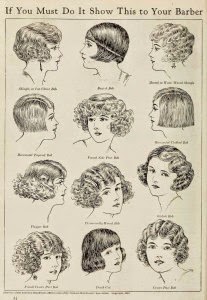
1920s:  In the 1920s there was quite a controversial change in women's hairstyling.  Differently from the long, flowing hair that used to be associated with femininity, short, cropped styles now symbolised the modern, bold, femininity.  This change in hairstyling during the 20s represented the beginning of change in society for women at this time.  The 3/4 bob was central to this change; a blunt cut that was level with the ears all around the head.  It was a simple style but dramatically different to what people were used to, and Irene Castle was the lady that triggered the new revolution of 20th century hair.  Irene Castle was a ballroom dancer, well known around 1915, who cut her hair short for convenience when dancing.  She designed, unintentionally, the hairstyle that was then known as the 'Castle Bob', becoming the first short hairstyle for women of the 20th century.  Women of the time quickly accepted the new hairstyle, as it gave them more confidence.
1920s hairstyles saw tight finger waves, pin curls and soft waves being created within hairstyles, with the hair being formed uniformly.  The typical 3/4 bob of the 1920s was often worn with bangs (fringes), or with the hair brushed off of the face.
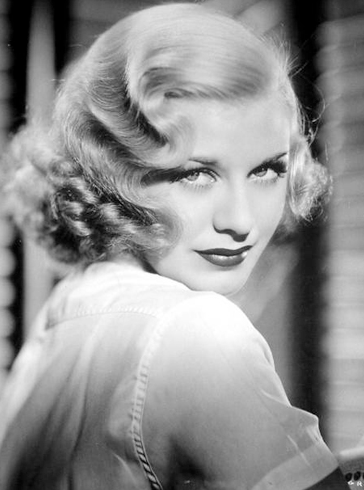
1930s:  In the 1930s, women still kept their hair short and creating curls and waves within their hairstyles was still popular.  Softer waves that were close to, or even slightly on the face, were fashionable, along with pin curls.  Finger waves and pin curls were used to create smooth lines within women's hairstyles, and softer waves were used to frame the face.  1930s hairstyles were very carefully sculpted and a lot more feminine than those that were fashionable within the 20s.  Popular kinds of hairstyles included the Saucer Wave, the Marcel Wave and the Sculptor Wave, with women creating deep side partings in order to gain a heavy wave that came across the face and adding accessories when they went to special events.
1930s Waved Bob
Available: http://hairstylesrocks.org/1930s-
hairstyles.html
1920s Hairstyles
Available: http://glamourdaze.com/2014/04/1920s-hairstyles-the-bobbed-
hair-phenomenon-of-1924.html


References:
- Anon. (n.d.). Women of the 1920s. Available: http://www.visitberlin.de/en/feature/women-of-the-1920s. Last accessed 5th Oct 2014.
- Anon. (2001). 1920s Makeup Guide. Available: http://www.return2style.de/swingstyle/makeup/20amimup.html. Last accessed 5th Oct 2014.
- Anon. (2001). 1930s Makeup Guide. Available: http://www.return2style.de/swingstyle/makeup/30amimup.html. Last accessed 5th Oct 2014.
- Forrest, M. (n.d.). 1930's Hairstyles. Available: http://www.erastyles.com/1930s-hairstyles.html. Last accessed 5th Oct 2014.
- Anon. (2010). 1930's Hairstyles. Available: http://www.dreamy-hairstyles.com/1930s-Hairstyles.html. Last accessed 5th Oct 2014.
- Forrest, M. (n.d.). 1920's Hairstyles. Available: http://www.erastyles.com/1920s-hairstyles.html. Last accessed 5th Oct 2014.
- Warner, M. (n.d.). The Bob. Available: http://www.hairarchives.com/private/1920s.htm. Last accessed 5th Oct 2014.

Friday, 3 October 2014

Studio: Abstract Painting with Aquacolour


Equipment needed:
- Aqua colour palette
- Water
- Make-up brushes

Instructions given...
We were given some instructions at the beginning of the class and then were left to do whatever we wanted with our aquacolour palettes.
- Choose any colours from the aqua colour palette and be experimental on your partners face
- Use a variety of brushes and/or sponges to create different textures on the face
- Apply the colours in an artistic style as if you are an artist, do not keep it neat
- Use different pressures and application techniques to create different marking effects

Evaluation:
I found this exercise fun because it allowed me to do what I wanted with the aquacolour palette.  I like using this product, as I find that it can be applied to the skin quite easily and it isn’t a very heavy product.


Wednesday, 1 October 2014

Research: Germany in the 1920s and 30s

Between the 1920s and 1940s, Germany was on the road from one war to another.  World War 1 ended on 11th November 1918 with Germany, France, Great Britain, Italy and the USA signing the Treaty of Versailles which was an agreement to cease fire and bring the war to an end.  From then on, Adolf Hitler and the Nazi Party began to rise.  It was arranged that Germany would pay back France and Great Britain for the damage of World War 1.  The USA agreed to lend Germany some money to help them with the reparations, with the promise that Germany would pay them back.  However in October 1929, the stock market in Wallstreet crashed and the USA wanted money from Germany.  This then lead to the Great Depression in both Germany and the USA, and prices in Germany kept on rising, leading to hyperinflation.

Having slowly made their way up by gaining votes and supporters, the Nazi Party became the largest party in the Reichstag (German government), and so on 13th August 1932, Hitler met with President Hindenberg and Chancellor von Papen.  He declares that he will not accept any role in the Reichstag other than chancellor, however Hitler is not made Germany's chancellor until January 1933.  Once he became Chancellor, he passed the Enabling Act, which allowed him and the Nazi Party to pass laws without having to get permission from the Reichstag.  The Enabling Act was what eventually enabled the Nazi Party to gain full power.

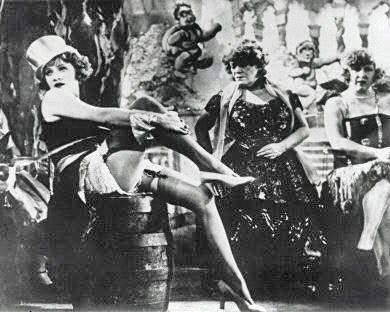
Whilst this was happening, Germany's population was full of contrast.  On the one hand there were people still struggling with unemployment and the deprivations off of the back of World War 1, whereas on the other hand there were the upper and middle class people turning cities, such as Berlin, around and embracing the things that they still had, such as entertainment and the arts.  Before this, Germany was primarily famous for it's leading roles in science, film, education and the government and it's military.  But with cities, such as Berlin, being turned into cosmopolitan cities, and the popularity of literature, the arts and fashion developed, it gave people a lease to have fun and enjoy themselves.  Places similar to the 'Kit Kat Klub' in Goodbye to Berlin and Cabaret became more popular at the time, entertaining people nationwide.

German Cabaret Showgirl, 1928
Available: http://musingsusingsandloosethings.blogspot.co.uk/2009/04/women-and-weimar-germany-1920s.html


References:
- Anon. (n.d.). Weimar Germany Timeline. Available: http://alphahistory.com/weimargermany/weimar-germany-timeline/. Last accessed 1st Oct 2014.
- Anon. (2010). Who signed the armistice in 1918?. Available: https://answers.yahoo.com/question/index?qid=20100720013350AAnRH3I. Last accessed 1st Oct 2014.
- BBC. (2014). The Wall Street Crash and Depression. Available: http://www.bbc.co.uk/schools/gcsebitesize/history/mwh/usa/walldepressionrev1.shtml. Last accessed 1st Oct 2014.
- Anon. (2014). 1920s Berlin. Available: http://en.wikipedia.org/wiki/1920s_Berlin#Life. Last accessed 1st Oct 2014.